

Executive Summary
India’s pharmaceutical industry is a global leader, known for its significant contribution to the worldwide supply of generic drugs. The country’s pharmaceutical exporters play a crucial role in this success, with several companies standing out due to their innovation, quality, and market reach. This report highlights the top 10 pharmaceutical exporters in India, examining their impact on the industry and the global market. Understanding these companies’ strategies and operations provides valuable insights into the dynamics of pharmaceutical exports from India.
Technical Analysis
Overview of India’s Pharmaceutical Export Industry
India’s pharmaceutical industry is the third-largest in the world by volume and 14th by value. The country is a major supplier of generic medicines, accounting for 20% of the global supply. The industry’s growth is driven by a combination of factors, including a strong domestic market, a skilled workforce, and a robust regulatory framework.
– Insight: The industry’s growth is supported by government initiatives such as the “Pharma Vision 2020,” which aims to make India a global leader in end-to-end drug manufacturing.
– Insight: The COVID-19 pandemic has further highlighted India’s role as a critical supplier of essential medicines and vaccines.
Interpretation: Strategically, India’s pharmaceutical export industry is poised for continued growth, driven by innovation and strategic partnerships with global markets.
Profiles of Top 10 Pharmaceutical Exporters
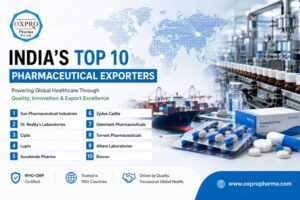
1. Sun Pharmaceutical Industries Ltd.
2. Dr. Reddy’s Laboratories Ltd.
3. Cipla Ltd.
4. Lupin Ltd.
5. Aurobindo Pharma Ltd.
6. Zydus Cadila
7. Glenmark Pharmaceuticals Ltd.
8. Torrent Pharmaceuticals Ltd.
9. Alkem Laboratories Ltd.
10. Biocon Ltd.
Each of these companies has established a strong presence in international markets through strategic acquisitions, partnerships, and a focus on research and development.
– Real point: Sun Pharmaceutical Industries is the largest pharmaceutical company in India and a leader in the global generics market.
– Real point: Dr. Reddy’s Laboratories has a strong focus on biosimilars and complex generics, enhancing its competitive edge.
Interpretation: These companies’ success is attributed to their ability to innovate and adapt to changing market demands, positioning them as leaders in the global pharmaceutical landscape.
Challenges and Opportunities in Pharmaceutical Exports
The Indian pharmaceutical export industry faces several challenges, including regulatory hurdles, pricing pressures, and competition from other emerging markets. However, opportunities abound in the form of increasing demand for affordable healthcare solutions and the expansion of healthcare infrastructure in developing countries.
– Real point: Regulatory compliance remains a significant challenge, with companies needing to adhere to stringent international standards.
– Real point: The rise of personalized medicine and biotechnology presents new avenues for growth.
Interpretation: Companies that can navigate regulatory complexities and invest in emerging technologies will be well-positioned to capitalize on future opportunities.
Implications for Stakeholders
For Startups
– Real implication: Startups can leverage India’s strong pharmaceutical ecosystem to innovate and enter niche markets.
– Real implication: Collaboration with established players can provide access to resources and expertise.
For Investors
– Real implication: The pharmaceutical export sector offers attractive investment opportunities due to its growth potential and resilience.
– Real implication: Investors should focus on companies with strong R&D capabilities and a diversified product portfolio.
For Policy Makers / Ecosystem
– Real implication: Policy makers should continue to support the industry through favorable regulations and incentives for innovation.
– Real implication: Strengthening intellectual property rights can enhance India’s competitiveness in the global market.
Action Points
For Early-Stage Startups
– Specific actionable step: Focus on developing innovative products that address unmet medical needs.
– Specific actionable step: Establish partnerships with academic institutions for research collaboration.
For Growth-Stage / Investors
– Specific actionable step: Invest in advanced manufacturing technologies to improve efficiency and compliance.
– Specific actionable step: Explore opportunities in emerging markets with high demand for affordable medicines.

Frequently Asked Questions
1. What are the key factors driving the growth of India’s pharmaceutical export industry?
– The growth is driven by a strong domestic market, skilled workforce, government support, and increasing global demand for generic medicines.
2. How do Indian pharmaceutical companies maintain their competitive edge in the global market?
– Companies focus on innovation, strategic partnerships, and compliance with international regulatory standards to maintain competitiveness.
3. What challenges do Indian pharmaceutical exporters face?
– Key challenges include regulatory compliance, pricing pressures, and competition from other emerging markets.
4. What opportunities exist for new entrants in the pharmaceutical export industry?
– Opportunities exist in niche markets, personalized medicine, and biotechnology, where innovation can lead to significant growth.
5. How can policy makers support the growth of the pharmaceutical export industry?
– Policy makers can support growth through favorable regulations, incentives for innovation, and strengthening intellectual property rights.